



By Will Burghes, Head of Professional Services, DV Rockerbox
When you set out to find a solution for multi-touch attribution, you might be tempted to build a custom solution rather than buy an existing one. Maybe you have an unusual channel footprint, a strong data science team, or a business complex enough that off-the-shelf software seems like a poor fit. These are reasonable motivations.
But many companies go into the process of building an MTA or marketing measurement solution only to find that it's far harder than expected. From the problem of identity resolution, to the difficulties (or sometimes total impossibility) of accessing view-through data from walled gardens, to the ongoing maintenance work it takes to manage a custom solution. It often makes more business sense to purchase an existing one.
In this post, we'll walk through what it actually takes to build the key components of an MTA solution from scratch, so that you can make an informed decision about whether building or buying a solution is right for your business.
What Goes into Building an MTA Solution?
At its core, multi-touch attribution requires you to stitch together a complete user journey across every marketing channel and touchpoint, deduplicate conversions against a single source of truth, and then build a model that distributes credit across that journey. That sounds simple enough. In practice, it involves at least six distinct work-streams, each with its own technical challenges.
1. Organizing Conversion Data
Before you can attribute anything, you need a clean, unified conversion dataset. For most businesses, conversions happen across multiple points of sale such as your website, a call center, an app, and sometimes in-store. To build an MTA product that gives a holistic view of your marketing impact on the bottom line, you need to reconcile all of them into a single event stream.
Rockerbox accomplishes this through three methods: system integrations, webhooks (an event-driven notification system that automatically sends data between applications), and batch files that automatically unify web, app, and offline conversions. As a brand building your own solution, you would need to construct your own conversion event pipeline and keep it maintained as your business evolves.
2. Identity Resolution
One of the hardest problems in attribution is identity resolution: the process of uniting a customer's disparate touchpoints with your brand into one cohesive profile. A single customer might click a social ad on their phone, visit your site on their laptop, receive a direct mail piece, and finally convert on their tablet. Connecting those dots requires a combination of first-party identifiers, secondary identifiers, cookie identifiers, and probabilistic approaches.
This is hard to do, and it’s getting even harder as third-party cookies are deprecated, privacy based restrictions increase and mobile identifiers become less available. To match the level of identity resolution that a dedicated measurement platform can offer, you would effectively need to construct your own synthetic methodologies and continually refine them as the landscape evolves.
3. Hard-To-Track Channels
Direct mail and linear TV present unique problems when building your own MTA model. Both are commonly used alongside digital channels, but consolidating that data requires approaches that are very different from tracking a click on a digital ad.
Linear TV requires a dataset with the start time of every user that arrives on your site so you can track spike visits after every TV commercial airs. This data should come from your server logs, since Google Analytics 4 only provides hourly granularity. If you're buying a lot of remnant TV, there's a chance that two commercials will overlap in the same time zone and you'll need a system to handle that. You also need to handle post-log files retroactively to update historical paths to conversion.
Direct mail requires cleaning address files from your vendors, each of whom will provide data in different formats. Some will only provide a hashed version, requiring you to build a per-vendor framework to ingest and normalize the data.
Each new channel you add comes with its own idiosyncrasies, and businesses building in-house face new hurdles with every adjustment to their marketing mix.
4. View-Through Data
This is where the build vs. buy decision often becomes most decisive.
Gathering click data is one aspect of building a path-to-purchase, but it doesn't account for an important category of marketing interactions: views. On visual platforms like TikTok, Snapchat, Pinterest, CTV, and programmatic display, views are necessary to understand the full impact of the platform on conversions and revenue. Click-only attribution systematically undervalues upper-funnel and video-based channels, because users on these platforms are far more likely to see an ad and convert later than to click through immediately.
Here's the problem: advertising platforms don't just give their view data to anyone. Rockerbox holds special partnerships with platforms like Meta, TikTok, Snapchat, Pinterest, and Reddit to receive view-through touchpoints that can't be obtained anywhere else. For platforms where data sharing is more restricted, Rockerbox uses proprietary synthetic modeling to estimate view-through impact.
The results of including view-through data speak for themselves:
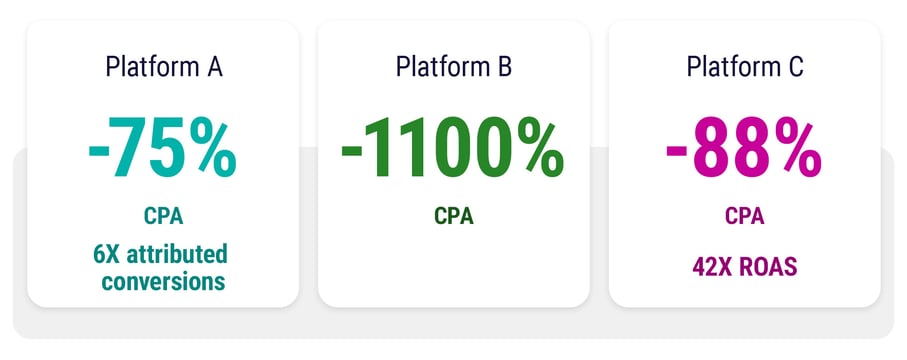
For an individual advertiser, getting access to this data typically requires establishing direct relationships with each platform, which is exceedingly difficult and in some cases simply not possible without the scale and partnerships that a dedicated measurement partner like Rockerbox brings to the table.
5. Data Granularity and Disparate Channels
Using an established MTA provider with strong industry partnerships allows for far more data granularity than a solution that relies more on UTMs. This granularity allows advertisers to go far deeper with their insights, down to specific campaign tactics. Beyond the major platforms, there are additional sources of data (including promo codes, post-purchase surveys, podcasts, influencers, affiliate networks, and more) that are pivotal to getting a full understanding of your customer journey but each require a unique process to incorporate into your model. Each new channel comes with its own integration requirements and idiosyncrasies.
6. Building a Data-Driven Attribution Model
Even after compiling all the necessary datasets, you still need to build the actual model. This involves categorizing all marketing touchpoints into a taxonomy, aggregating them into user-level timelines, separating converters from non-converters, and running a logistic regression or similar model to determine which touchpoints are most influential in driving a conversion. As your channel mix evolves, there's a considerable amount of ongoing work involved in calibration, monitoring, and maintenance.
The True Cost of Building
It's worth being honest about what building a custom MTA solution actually costs. On the very low end, you would need several dedicated engineers and 12-24 months to build it. Plus, a project manager to manage the build, a program manager to manage the outputs, and at least two data scientists to handle the attribution side. Altogether, you could budget up to $2 million to build it out internally.
But the initial build is only the beginning and the ongoing costs are significant. Models degrade without frequent refreshes, every new channel or significant shift in spend requires recalibration, and privacy regulations are a constantly moving target. Every time a platform changes its data schema or authentication requirements, your team has to react or risk losing data. Realistically, maintaining a custom solution requires multiple dedicated FTEs at a cost of $400–600K+ annually in staffing and infrastructure.
Compare that to weeks-to-value with a managed solution and a predictable subscription cost — and a vendor like Rockerbox that monitors industry changes and updates its software accordingly — and the math becomes hard to argue with for most organizations.
The Advantages of Buying
Buying an existing MTA solution like Rockerbox doesn't mean giving up control. It means accelerating time-to-value while gaining access to capabilities that would be extremely difficult or impossible to replicate in-house:
Speed to value: Deploy in weeks, not months. Most brands are up and running with core MTA reporting within four to eight weeks.
Proven methodology: A battle-tested logistic regression framework refined across hundreds of implementations. Rockerbox has seen what works and what doesn't, and those lessons are baked into the platform.
Data access: Over 100 integrations across digital, offline, and walled-garden channels. Critically, this includes view-through data from platforms like TikTok, Snapchat, Pinterest, and Reddit through direct partnerships—data that individual advertisers typically cannot access on their own.
Vendor-managed maintenance: Calibration, model refreshes, privacy updates, and integration maintenance are all handled by Rockerbox, freeing your team to focus on insights and execution instead of infrastructure.
Hybrid flexibility: For businesses with unique needs, Rockerbox's data warehousing capabilities let you export complete, analytics-ready marketing datasets into Snowflake, BigQuery, or Redshift for custom analysis on top of Rockerbox outputs. You get the best of both worlds. This approach eliminates the challenging parts of building while preserving full flexibility for custom analysis and other bespoke adjustments.
Real Results From Brands That Chose To Buy
The impact of switching from homegrown or limited measurement to Rockerbox MTA is well documented:
 Away discovered that Meta's revenue contribution was 6x higher in MTA than last-click, enabling them to double their Meta investment YoY.
 SEMrush uncovered undervalued performance in paid video and paid social, resulting in a 7.1% measurable lift from more informed budget allocation.
 3Z Brands turned fragmented data into a single source of truth, enabling portfolio-level modeling and cross-brand benchmarking.
Are You in the Business of Attribution or Are You in the Business of Your Business?
The question isn't whether your team is capable of building an MTA solution. The question is whether that's the best use of their time. In the end, it's a matter of where you want to spend your time and budget. Building an MTA solution for your business is like building your own CRM. You could do it, but there are companies whose entire business revolves around doing it better.
Ready to see what Rockerbox MTA can unlock for your business? Request a Demo to learn how we can support your measurement strategy.