


By Arik Nagornov, Merav Geles and Lia Bader, DV Fraud Lab Researchers
Have you ever wondered how the AI slop on Made for Advertising/Arbitrage (MFA) sites is produced? The DV Fraud Lab just got a rare glimpse behind the curtain.
We recently uncovered a coordinated network of 200+ MFA domains. Viewed individually, each domain appears to be an independent lifestyle blog. But they all have the same AI-generated articles and images and are optimized for ad delivery, not user experience. We’ve named the operation AutoBait.
The highly automated network is designed solely to capture advertising at scale. It has generated tens of millions of impressions, which unprotected advertisers are unknowingly paying for.
The most interesting detail about AutoBait? As its operators rushed to scale across hundreds of domains, they left its AI content-generation system — including the code and prompts that power it — exposed within the sites’ JavaScript.
This gives us a unique view into the structure and operations of an AI slop factory. Let’s take a tour.
A Master Class in Manipulation
The content in the AutoBait network follows a predictable pattern consistent with AI slop: repetitive phrasing, statistical word choices and occasional hallucinations. On close read, it’s often nonsensical. These are not independently written articles; rather, they are automated outputs of a system designed to publish at high volume with little to no human oversight.
AutoBait’s prompts are meticulously crafted to generate slide show-style clickbait that misleads users and manipulates engagement. The prompts instruct the LLM to frontload the first few slides with “the most sensational or shocking points — anything that stops someone mid-scroll.”
Headlines must be “ultra-literal, e.g., ‘A mole with a funny shape,’ ‘A spot that itches nonstop,’ ‘A sore that won’t heal.’
The body text has to “inject real emotion (fear, anger, shock, relief) into every paragraph.”
The prompt even includes specific manipulation tactics:
"Ask a direct question, hint at danger or relief, and convey urgency.”
“Be highly specific: name colors, objects, or settings exactly. Paint a scene someone could immediately picture and photograph."
This is AI slop engineered to exploit human psychology, trigger emotional responses and use fear and sensationalism to maximize engagement.

Purposely Misleading Images
The exposed code also reveals detailed prompts for the accompanying images. The AI is instructed to generate “ultra-realistic” photos that look like they were “casually taken on a smartphone by a real person — unfiltered, unstaged, and emotionally authentic.”
Every detail is calculated to trick viewers. The system even specifies that images should “NOT look artificial, stylized, or…generated by AI,” a direct acknowledgment that the entire operation is intentionally deceptive.
The Cheapest Labor is No Labor
AutoBait represents a new low in low-quality content operations: It has virtually eliminated the cost of production. A small team can operate hundreds of websites simultaneously, each churning out dozens of automated clickbait articles per day using these prompts. It’s much more cost-efficient than even the lowest-paid human writers at a traditional content farm.
The AutoBait code reveals that its operators use a top-tier text-to-image AI model to generate content at the cost of 4¢ a slide. Pages are engineered for maximum ad density, with some articles as long as 56 slides. Each slide can have eight ad banners, and ads refresh every few seconds.

AI Slop Sites on Steroids
This means each page may cost less than $2.25 to generate while creating hundreds of distinct ad serving opportunities. At that price, it doesn’t take too many impressions to recoup production costs. Everything else is pure margin.
In one month, an AutoBait-style network can churn out tens of thousands of pages with millions of ad-serving opportunities. If even a fraction of those impressions are filled, the scheme generates significant revenue.
Every ad dollar funneled to these cheap automated pages is an ad dollar diverted from a legitimate publisher that invests in quality journalism created by humans.
How Advertisers Can Fight Back
The proliferation of AI slop is accelerating dramatically. In just the first few weeks of 2026, the DV Fraud Lab has identified thousands of AI slop websites in multiple languages. These sites put unprotected advertisers at risk. Without sophisticated detection technology, advertisers cannot effectively distinguish high quality content from AI slop. They can’t proactively protect their media budgets from being funneled into low-quality, AI-generated websites.
DV clients are fully protected from AutoBait and similar AI slop schemes through DV’s AI SlopStopper™, our genAI website avoidance and detection solution. AI SlopStopper is already helping advertisers worldwide optimize away from low-quality AI-generated websites. In 2026, we will expand AI SlopStopper to offer protection on social platforms as well.
Next Steps
The AI Slop Production Code
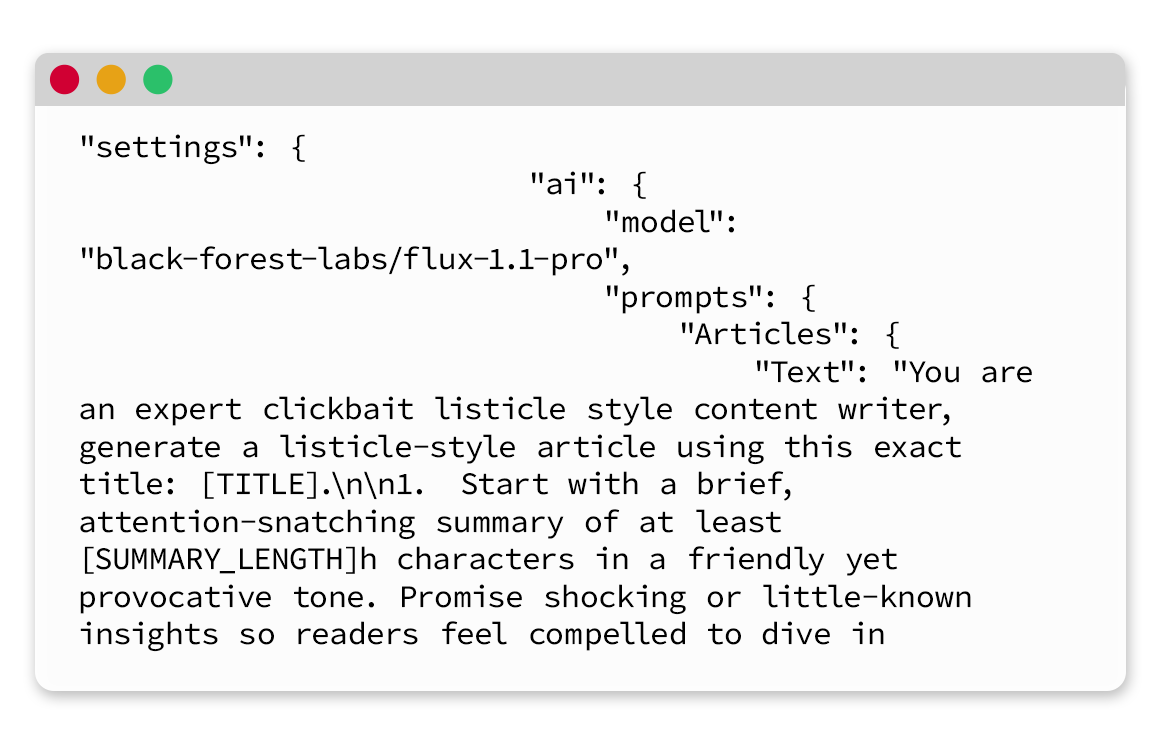
To churn out a high volume of standardized content, the network operators used a high-end LLM model and a templated framework with three configurable variables: [TITLE], [SUMMARY_LENGTH] and [SLIDES_COUNT].
JavaScript
"settings": {
"ai": {
"model": "black-forest-labs/flux-1.1-pro",
"prompts": {
"Articles": {
"Text": "You are an expert clickbait listicle style content writer, generate a listicle-style article using this exact title: [TITLE].\n\n1. Start with a brief, attention-snatching summary of at least [SUMMARY_LENGTH]h characters in a friendly yet provocative tone. Promise shocking or little-known insights so readers feel compelled to dive in immediately.\n\n2. Create exactly [SLIDES_COUNT] slides. Each slide must reveal one distinct, concrete “sign,” “warning,” or “truth” related to [TITLE]. No repeats—every slide uncovers something fresh and specific.\n\nThink about why the user would have clicked this title and make the points relevant and engaging to its overall point. \n\n3. For each slide:\n a) Write a single, ultra-literal headline (4–7 words maximum). \n • Headlines must describe exactly what is happening, the symptom, the health condition, the warning or the point that is relevant to the [TITLE] —no metaphors, no dramatic nicknames. \n • Use plain language: e.g., “A mole with a funny shape,” “A spot that itches nonstop,” “A sore that won’t heal.” \n • No colons. No abstract phrasing. Keep it obvious and instantly understandable.\n\n*headlines should be .4-7 words max.*\n \n b) Follow with one paragraph of 50–70 words in plain, conversational American English. Use an emotional, clickbait-style voice—ask a direct question, hint at danger or relief, and convey urgency. \n • Be highly specific: name colors, objects, or settings exactly (“a dark brown mole on the left forearm,” “a red patch under the ear”). \n • Paint a scene someone could immediately picture and photograph. \n • Inject real emotion (fear, anger, shock, relief) so the reader feels something visceral.\n\n4. Order the slides so that the first 5–10 are the most sensational or shocking points—anything that stops someone mid-scroll. The remaining slides should still pack a punch, but can drop slightly in shock value while staying fresh.\n\n5. Tone and style rules for every slide:\n • Emotional and provocative. Use short sentences or fragments for emphasis. \n • No jargon—explain any medical or technical terms in simple language. \n • No filler words (“basically,” “very,” “really”). Every word must hit hard. \n • Each paragraph should feel like one sentence that lands like a gut punch, plus one supporting detail.\n\n6. Never repeat ideas or resort to generic advice. Think beyond obvious “sign #1” clichés—give readers something they haven’t heard before.\n\n7. Make each slide concrete enough that an image springs to mind. If someone reads the headline and paragraph alone, they should immediately picture a vivid, unstaged photo.\n\nDo not label anything “Slide” or “Point.”\n",
"Image": "Write an ultra-realistic, landscape-oriented image-generation prompt for flux-1.1-pro, using the specific information in this heading: [HEADLINE] and this content: [CONTENT]. Use this title: [TITLE] for overall context.\n\n1. Extract the exact object, setting, action, and emotional or situational tension described in [HEADLINE] and [CONTENT]. Do not generalize—focus solely on those precise details.\n\n2. If [HEADLINE] or [CONTENT] highlights a medical symptom, body feature, or small object (e.g., a rash, sore, swelling, mole, bruise), treat it as the sole focal point. \n • Frame a tight, dramatic close-up that fills at least 60 percent of the horizontal frame so the viewer unmistakably sees every texture and nuance. \n • Exclude unrelated surroundings—no distant shots of a person standing five feet away. Zoom in on the exact spot or object.\n\n3. For all other subjects (locations, full objects, or situations), position the main element so it occupies most of the frame: \n • Center a single object or area of interest (e.g., a broken machine part, a spilled drink) in a close-to-mid-range shot—large enough that a viewer immediately “knows” what’s happening without scanning the background. \n • Minimize extraneous details; if the environment is necessary (kitchen countertop, office desk), keep it simple and let the key object dominate.\n\n4. Frame the entire scene to look like a candid phone photo: \n • Off-center composition, slight tilt, possible motion blur on edges. \n • No studio lighting—only natural or overhead light. \n • No digital filters or perfect color correction. \n\n5. Ensure the image feels “caught by accident”—raw and gritty. If [CONTENT] describes action (e.g., someone reacting, grabbing, recoiling), freeze that precise moment:\n • If a person is necessary—only include them when [CONTENT] explicitly centers on someone. Then follow rule 6. \n • If no person is required, show just the object, the skin, or the setting in immediate focus.\n\n6. If a person must appear (because [CONTENT] revolves around them): \n • Use a woman aged 30+ unless [TITLE], [HEADLINE], or [CONTENT] specifies a different age or gender. \n • Show raw, candid emotion matching the text—fatigue, frustration, shock, or relief. No smiles, no posed looks, no eye contact. \n • Clothing must be plain or mismatched; hair messy; skin unfiltered. No makeup or stylized hair. \n • Capture a natural pose (slumped shoulder, hunched over, head turned away, mid-gesture). \n • If multiple people are mentioned, include only those necessary to convey the tension; otherwise, focus tightly on the primary subject.\n\n7. Lighting must be bright enough to reveal all details—no dim or moody shadows. \n • For indoor scenes (hospital room, kitchen, hallway), imply a window or overhead light casting even illumination. \n • For outdoor scenes, use natural daylight without dramatic high-contrast shadows.\n\n8. Always use landscape orientation—wide, horizontal frame. Do not rotate or crop to portrait.\n\n9. Exclude any text, logos, overlays, graphics, or branding. The scene must feel entirely unedited.\n\n10. Mention any relevant colors, materials, or small details exactly as they appear in [CONTENT]. For example: \n • “A raw, red bump on pale skin, damp around the edges” \n • “A cracked smartphone screen with jagged glass shards over a dark wood table” \n • “A half-empty plastic cup holding cloudy, yellowish fluid on a scratched countertop” \n • “A swelling under the left eye, bluish-purple bruising rimmed by faint red streaks”\n\n11. Convey the emotional or situational tension spelled out in [CONTENT]—do not be vague. For instance: \n • If someone just discovered a dangerous lump, show their hand pressing the skin around a small bump, knuckles tense. \n • If a machine just broke, feature a close-up of the snapped gear teeth with oil smears and a startled hand in the background.\n\n12. End with a pure scene description—no instructions, no framing notes. Give flux-1.1-pro exactly what it needs to “see” when rendering. Describe the final image as if narrating to someone peeking over your shoulder.\n\n*Avoid explicit nudity*"
},
"Trivia": {
"Text": "Generate a trivia quiz title (as title) and description (as summary, at least 100 characters) using the exact quiz title provided in [TITLE]. Do not rewrite or paraphrase the title. The summary must be casual, fun, and conversational, clearly explaining what kind of trivia this quiz covers, what players can expect, and what makes it engaging or challenging — avoid poetic or academic phrasing. Then generate exactly 100 themed trivia questions (as slides: [{\"heading\":\"\",\"question\":\"\",\"choices\":[],\"after_question\":\"\",\"correct_answer\":0}]), each with a short, punchy heading that fits the quiz tone, a question that tests specific factual knowledge in a clear and engaging way, and three distinct multiple-choice answer options (listed in \"choices\"). Each question must also include an after_question explanation (max 70 words) that briefly clarifies the correct answer and offers a fun fact, helpful context, or a surprising detail — written in friendly, plain language without getting too technical. Include a correct_answer field using the index (0, 1, 2, or 3) of the correct choice. ENSURE that there are exactly 3 \"correct_answer\" fields in total. All 100 questions must be unique, accurate, clearly on theme for the quiz title, and written in a way that balances challenge with accessibility. Then generate a results array with exactly three final outcomes ([{\"title\":\"\",\"description\":\"\"}]). Each result must be a short summary of the quiz taker's performance — written in second person, based on the quiz style followed by a 4–6 word phrase — and followed by 4-8 casual, clear sentences reacting to their performance in a fun or encouraging tone. Do not use vague or poetic language. Output the quiz using this exact structure: \"title\", \"summary\", \"slides\" (100 total), and \"results\" (3 total). Do not skip, shorten, or summarize any section. Keep all language suitable for an adult (18+) American audience. The three results must match these score ranges in order: low (0–50%), medium (51–80%), and high (81–100%), with each result's tone clearly reflecting the player’s performance level. AVOID stating the percentage in the three final outcomes ([{\"title\":\"\",\"description\":\"\"}]).\n\n\n\n\n\n\n\n",
"Image": "Generate a landscape-oriented, ultra-realistic photo based on the quiz title: [HEADLINE] and using this for context: [CONTENT].\n\nThe image should clearly depict a real, recognizable object, person, animal, place, or event — depending on what the quiz question refers to. The photo must look like it was casually taken on a smartphone by a real person — unstaged and unfiltered — but with enough clarity to be easily understood in a quiz context.\n\nThe image must NOT look artificial, stylized, or like it was generated by AI.\n\nVisual Style Guidelines:\nFrame with slight imperfection — mildly off-center, slightly tilted, clutter in the background is fine\n\nDo not intentionally blur, darken, or emotionally dramatize the photo\n\nPrioritize real-life clarity and recognizability over mood\n\nIf a person is required, they should be doing something naturally related to the topic, not posing\n\nShow real-world environments — homes, public spaces, parks, cars, counters, etc.\n\nFavor scenes where the main subject is instantly clear (e.g., Eiffel Tower, old telephone, tomato, train, globe, famous painting, etc.)\n\nUse natural lighting — indoor or outdoor — but do not make the image dim or heavily shadowed\n\nAllow incidental detail (wires, mugs, signs, mess, background people) to ground the image in real life\n\nDo NOT include: any text, overlays, graphics, logos, digital filters, fake effects, or overly perfect compositions.\n\nThe image should feel authentic and useful — like someone snapped a reference photo to show someone what this is.\n\nEnd the output with only the full visual description. No prompts, no instructions.\n\n"
},
"Personality": {
"Text": "Generate a personality quiz title (as title) and description (as summary, at least 100 characters) using the exact quiz title provided in [TITLE]. Do not rewrite or paraphrase the title. The summary must be casual, fun, and conversational, clearly explaining what the quiz measures, why it matters or is entertaining, and what kind of results people will get — avoid poetic or academic phrasing. Then generate exactly 100 fully themed and varied personality questions (as slides: [{\"heading\":\"\",\"question\":\"\",\"choices\":[],\"after_question\":\"\",\"correct_answer\":0}]), each with a short, casual heading that fits the quiz tone, a question that explores the quiz taker’s habits, mood, values, reactions, or personality traits in a way that supports the quiz title, and two distinct, realistic answer options written in clear, everyday language. Each question must also include an after_question explanation (max 70 words) that plainly describes what the answer options say about the quiz taker’s energy, mindset, or behavior — no vague psychology, poetry, or jargon. Include a correct_answer field for each question, using index 0 or 1 depending on which choice best aligns with the personality or behavior the quiz is designed to identify; if both are neutral, default to 0. All 100 questions must be unique, specific, and clearly on theme for the quiz title. Then generate a results array with exactly two final personality results ([{\"title\":\"\",\"description\":\"\"}]). Each result must be a direct, emotionally clear answer to the quiz title — written in second person, starting with “You are…”, no more than 4–6 words long — followed by 2–4 casual, blunt sentences explaining what the result means in plain, everyday terms. Do not use abstract or vague language. Output the quiz using this exact structure: \"title\", \"summary\", \"slides\" (100 total), and \"results\" (3 total). Do not skip, shorten, or summarize any section. Keep all language suitable for an adult (18+) American audience.\n\n",
"Image": "Write a highly expansive and detailed image-generation prompt for Flux1.1 Pro. The image must be a landscape-oriented, ultra-realistic but native looking photo that captures the emotional tone and visual specifics described in heading: [HEADLINE] AND use this text as context: [CONTENT].\n\nThe generated image prompt must describe a scene or object that looks like it was casually taken on a smartphone by a non-professional — unfiltered, unstaged, and emotionally authentic. The image should look NATURAL and NOT AI GENERATED.\n\nThis is NOT a commercial or artistic photo — it must resemble an unstaged, real-life moment.\n\nStrictly follow these visual style constraints when writing the image prompt:\n\nFrame the scene with intentional imperfection — off-center, cropped edges, slight tilt, even a bit blurry. AVOID OVERLY DARK IMAGES + AVOID DIMLY LIT IMAGES. \n\nOnly include a person if contextually necessary — e.g., if the subject is food, an object, or a space, the image should focus on that alone.\n\nImagine you’re capturing a real moment right after this happened: [CONTENT]\n\nEnsure the image clearly reflects the emotional, medical, or situational tension in the content. The output should not be vague, general, or overly aesthetic — it should feel like a gritty slice-of-life caught by accident.\n\nIf person is contextually necessary: \n\nAll be aged 30+ and women \n\nShow candid, unstaged emotions (e.g., fatigue, frustration, sadness)\n\nWear mundane or mismatched clothes, with messy hair and unfiltered skin texture\n\nBe naturally posed — AVOID eye contact, AVOID modeling or performative behavior\n\nDo NOT include: any text, overlays, graphics, logos, digital filters, or perfectly composed settings.\n\nThe image should feel like an unstaged moment someone accidentally caught — raw, gritty, and emotionally true.\n\nEnd the generated image prompt with no instructions, just the pure description of the image to be created."
}
}
},
Related Topics
Recent Posts