

Discrepancies are an unfortunate reality of the billing process in digital advertising. As long as campaigns are billed through anything other than a first-party ad server, not every line item will line up. But in order to prevent small issues from growing, publishers need effective processes and a well-equipped ad ops team to correct discrepancies whenever and wherever they might appear.
What Causes Discrepancies in Direct-Sold Advertising?
Discrepancies are the result of a local (publisher) ad server and a third-party (advertiser) ad server having conflicting data about delivered impressions. Usually, one server either omits the impression entirely or records it in a different way, but the end result is always the same: an incongruent count that must be resolved.
Discrepancies can come from a number of different variables, including:
- Missing or incorrect tags and mappings
- Unoptimized scripts
- Under-performing tracking pixels
- Excessive use of trackers and scripts
- Faulty markup code
- General server latency
- Delivery misfires
Wherever discrepancies occur, the actual difference between the buyer’s and seller’s numbers is the biggest clue to what the underlying issue might be.
When the Buyer’s Number Is Less Than the Publisher’s Number:
|
Amount |
Potential Cause(s) |
|
Small (1-10%) |
Overall platform latency. Generally unavoidable due to the nature of the ad delivery chain. |
|
Medium (10-20%) |
Tag performance due to too many trackers or poor optimization. |
|
Large (>20%) |
An operational issue that needs further investigation. |
When the Buyer’s Number Is More Than the Publisher’s Number:
|
Amount |
Potential Cause(s) |
|
Small (1-10%) |
Payment for test impressions that the publisher didn’t deliver. |
|
Medium (10-20%) |
A tag is probably being delivered across other channels (e.g. through a DSP or executing audience extension). |
|
Large (>20%) |
A buy-side error, such as instances of a tag being reused across multiple publishers. This may also be considered fraudulent and is therefore a critical area to monitor. |
The Potential Hazards of Discrepancies
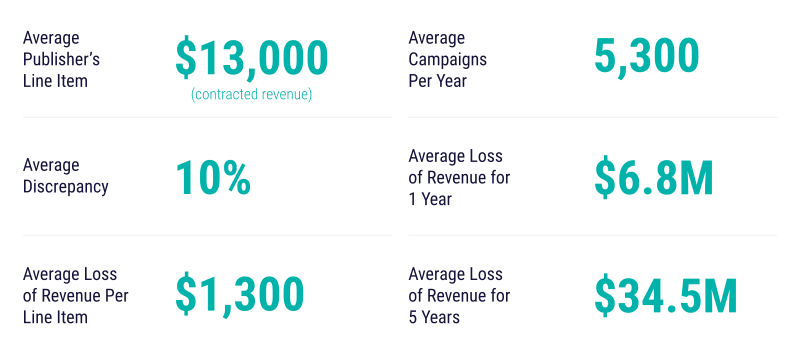
Impressions are finite. Without a reliable count, publishers could end up over- or under-delivering on their commitments. This creates something called impression waste, which teams on both sides are always hoping to avoid.
To make matters even more complex, over- and underdelivery are not mutually exclusive problems. Both can happen at the same time, even as a result of one another. For instance, over-delivering on one contract could leave a publisher without the impressions they need to fulfill another.
Best Practices: What Can Be Done about Discrepancies?
Due to the snowball effect that discrepancies can have, it is important to be proactive about keeping them in check. Here are some ways to stay ahead of the curve.
Limit Reliance on Buffering
Buffering refers to a “safety net” of impressions that publishers deliver to ensure that campaign requirements are met. In some cases, the average buffer can run up to 15% of any line item. With an effective discrepancy plan in place, publishers may consider keeping buffers as small as possible in order to maximize impression solvency while minimizing delivery constraints.
Empower Ad Ops
Invest in ad ops solutions that can identify, report and reconcile discrepancies. Prioritizing ease of use is a great way to cut down on the time and training needed to get team members up to speed.
Monitor, Monitor, Monitor
Keep an effective lookout by executing discrepancy and inventory optimization processes frequently. The most effective publishers do this on a daily basis in order to be as certain as possible that they’re staying ahead of any potential problems.
With the right approach to discrepancies, publishers can deliver performant campaigns accurately, minimize costly makegoods and realize more revenue potential across their inventory.
Want to learn about how DV Publisher Suite enables teams to proactively manage discrepancies? Contact us today!
Related Topics
Recent Posts